August 19, 2012

Hunting Party - Sub Rosa with Whispered Pacts 7" (Hesitation Wound records)

I'm probably already late to the party when it comes to this band (the hunting party in this case), as their demo already came out last year and I can't believe I have been sleeping on it! I had heard their name going around, but it wasn't until their debut 7" dropped on my doormat earlier this week that I actually got to hear them. And I have been hooked since. Therefore, despite the ridiculously hot weather today, I felt the need to stay inside for a little while at least and spent some words on this really cool EP.

Like Synthetic ID, Hunting Party is a fairly new band from the San Francisco Bay Area that features (ex-)members of several other noteworthy hardcore bands from the past couple of years (i.e. Nightstick Justice (again), Ecoli, Migraine, Desolation, Vaccuum, and others). Being from the West Coast, it's interesting to see that musically they ended up sounding like a band that would have had no problem fitting in at an ABC No Rio gig in New York about 20 years ago. That period in the early- to mid-90ies in which bands on the East Coast of the U.S., were giving hardcore a much needed punk (i.e. DIY, non-jock, non-crossover) kick in the ass. Think Born Against, Rorschach, Citizen's Arrest and that 'Nothing's Quiet on the Eastern Front' compilation Lp. One of the things the feel of this record specifically reminded me of somehow was the great (and unfortunately all but forgotten) Eucharist Lp on Mountain records, except that it's more distorted and blown-out musically.

Despite these historical reference points, one of the coolest things about this EP to me, is that it doesn't feel like this band set out to sound like any particular other band or style per se. It sounds like they just ended up with this sound as a result of mixing all these different influences with genuine anger and energy. What I'm trying to say is: it doesn't sound contrived. They're not trying to follow a certain blueprint or something. I could have easily named tons of other reference points that came to mind while listening to this: Balance of Terror, The Swarm, Econochrist, Sacred Shock or the way the vocals on the first track reminded me a little of the Nerve Agents. And still, it doesn't sound exactly like any of the aforementioned bands. It just sounds like what it is: fucking angry, energetic, no frills, no bullshit hardcore punk. And of that, I can never get enough.

To close this off: I read somewhere that for their next 7", Hunting Party is teaming up with Iron Lung records, and that makes total sense as this band will apeal to the same people that also love stuff like Herds, White Wards, Walls and Artimus Pyle. I'm going to leave you with this cool live clip of Hunting Party playing live in May of this year. Be sure to check out this band!     


August 14, 2012

Synthetic ID - White Walls 7" (Satellite Visions/Cut The Cord That... records)

I was immediately intrigued by the very sober artwork on this release. The black and white image on the cover, at first glance, looked somewhat like a giant barcode. Closer inspection made me suspect that in fact it might be a manipulated image of the side of a skyscraper or an office building; quite possibly the Twin Towers on 9/11. In which case the little black dots at the bottom of the image might just be people falling from the windows, but I admit: this is purely my personal interpretation of the image and is therefore all highly speculative. Ergo: the image remains a mystery.

Let's try to shed some light on the music then: Synthetic ID is a fairly new band from the San Francisco region. They debuted with a three song tape last year, and this 7" is the vinyl version of that tape. Apparently Synthetic ID features (ex-)members of several different bands from the Bay Area, of which Nightstick Justice and Deadfall are best known to me. But whereas those bands went for relatively straight-forward, fast, 80-ies inspired hardcore, Synthetic ID walks a different path. Looks like these guys traded in their Negative Approach and Infest records for copies of 'Pink Flag' for some post-punk inspiration. Nothing wrong with that of course, especially as they shun from sounding 'retro' in any way. Being from the Bay Area, I can imagine these guys sharing a lot of bills with fellow locals Rank/Xerox. Other comparisons that came to mind were Autistic Youth or a less-melodic Observers, especially on the last song on this EP: 'Throwaway'.

Lyrically, the songs on side A are the most interesting in my opinion. They deal mostly with the singer's feelings of anxiety about being stuck and wanting to escape from a sterile existence:

"Oh my world, so orderly.
Boxed in white walls, so neat.
They think that my instincts have died.
But behind the facade a beast resides."
- from 'White Walls'

and

"I'm of an anxious mind when I can't move.
A faceless face in the multitude.
Confined within these stark confines.
With nothing but this unease of mind."
- from 'Between the Lines'

These sentiments fit the music well, as you can literally almost feel the singer's pent-up restlessness in his monotonous, shouted way of singing and in the angularity of the songs.

All in all, this 7" lasts only a few minutes, but in those few minutes, Synthetic ID have managed to make quite an impression on me with these three songs. I'm very curious to see where they'll go next and am looking forward to hearing more!         


August 12, 2012

1981 - Cycle b/w Symptom 7" (Profiteer records)

I picked up 1981's first 7" at the tail end of 2010  after reading a very positive review of it in MRR. To say I was not disappointed would be a giant understatement. That 7" has since been (and still remains) a frequent visitor to my recordplayer.  

Whereas that first MRR review mentioned The Ex, Minutemen and The Jam as references to the band's sound (and I can see how all of those would come to mind), 1981 draws most of its musical and stylistic influences from the melodic end of early/mid 80-ies U.K. anarcho-punk (think Chumbawamba, Zounds, The Mob, Rubella Ballet, etc.) In that sense, these Finns are contemporaries to North-American bands drawing on the same influences, such as Surrender, Arctic Flowers, Bellicose Minds, Vivid Sekt and Spectres (whom I have written about before).

Since hearing that first 7", I have made sure to track down a copy of their demo tape, as well as of all their subsequent releases (another 7" ('Decay') and a split EP with the aforementioned (and equally excellent) Surrender from the Bay Area). I'm guessing that all of their releases should still be relatively easy to find. And believe me, you need to hear these songs! For those of you not interested in vinyl or tapes, they have all been recently compiled on CD-r by French label Plus Ques Des Mots under the title: 'The Only Government is Yourself (2009-2011)' It's definitely nice to have all these songs compiled in one place, but what makes this partial discography really worthwile is the silkscreened artwork, which looks really nice, and the included booklet containing the band's lyrics, as well as an interview with the band in both English as well as French. Definately worth your money, especially considering the fact that the label is selling these for 2 euros apiece.
   
What the CD-r doesn't include is the band's most recent output: a new two song 7". The songs are entitled 'Cycle' and 'Symptom'. Musically there are no surprises here, as these songs fit in nicely with 1981's previous releases: catchy, almost poppy anarcho-punk with dual male and female vocals. I already mentioned the bands that 1981's sound reminds me of, but on this 7", they sound even more like 'Nevermind the Ballots'-era Chumbawamba than on their previous releases. Especially one break in the song 'Cycle' could be taken straight out of the song 'Revolution' from the first Chumbawamba 7".

As said, there's nothing unexpected here and these are two very solid 1981 songs, that keep popping into my head constantly. That said, I find myself a bit puzzled as to why I still feel a little bit unsatisfied by this release. Maybe I was expecting too much. On some level I was hoping for 1981 to have pushed themselves a bit further with this new material in terms of creativity. And by that I don't mean in any way that they should give up writing catchy, heartfelt punk song in favor of some more 'mature' sounds or something. Heaven forbird... But after listening to this record, I am a bit left thinking that I have heard these two songs before and that it sounds a little too familiair, if you know what I mean. Still, this is waaaaaaayy better than 99% of stuff out there and you seriously need to check out this band if you haven't yet.    


August 9, 2012

Poliskitzo - Dulce Del Systema 7" (Todo Destruido records)

What you have here is one of the best 7"-es to have come out in the past couple of months. That's my humble opinion at least. This EP is the four song vinyl debut of L.A.'s Poliskitzo. Hailing from the City of Angels, this band is part of the local 'raw ponx' scene there, which produced some really cool bands in the past couple of years (on that note: expect to see a review of the recent Rayox X Lp up here soon as well).

Musically, Poliskitzo are somewhat less 'raw' then the scene they're from would suggest. Don't get me wrong, their sound can by no means be called polished. But what you'll find underneath the grit are some extremely catchy and well crafted melodic tunes drawing more from late 70ies/early 80ies punk (especially Spanish punk from that era), then it does from the hardcore bands of that age.

It's always easy to start throwing around names, but with the Eskorbuto shirt one of the bandmembers is wearing on the cover of this 7", it's almost impossible not to make that particular reference. They do seem an obvious influence while listening to this EP, but I can also see members of Poliskitzo as having spend plenty of time listening to their copies of 'No te Muevas!' or the La Uvi 7". Other (more recent) bands that came to mind while listening to this were Los Monjo (especially because of the driving bass) and Ruleta Rusa (and their predecessor: Peligro Social). Fans of any of the aforementioned bands will no doubt like this as well.

However, simply comparing them to what other bands are doing or have done in the past, does not convey adequately my enthusiasm for this release. So in case I haven't made my point yet, let me say it again: this is really, really good!!! Maybe it's because they already put out two (!) demos before committing any of their songs to vinyl, but on their first 7" they already sound like they have created a sound that is truelly their own and that they're very comfortable playing. Can't wait for more!


Not convinced? Listen for yourselves...
POLISKITZO - DRUM SOLO 

P.S. If anyone can hook me up with copies of their demos, it would be greatly appreciated!!
P.S. 2 For copies of this record, get in touch with Todo Destruido Records

August 29, 2010

Speak Loud, Speak Truth

I was away on holiday in France for a few weeks, hence the lack of updates. To make up for it, here's some footage I came across recently on youtube of one of the greatest (and often overlooked) hardcore bands to have come out of Washington DC in the 1980s: Ignition. I strongly recommend everyone who isn't familiar with their music to seek out their 'Complete Services' discography Cd. Also, Dischord records recently did a limited repressing of the band's second Lp, The Orafying Mysticle of... which you can still purchase through the label's webstore. In all fairness, I prefer the first Lp and both 7"-es over this Lp, but their entire output is amazing. Enjoy!


August 6, 2010

Spectres - Last Days Lp (Whisper in Darkness records)

Not having heard anything from British Columbia's Spectres after their two decent 7" EP's on Whisper in Darkness records from a few years ago, I wasn't sure whether this band was still active. With this new release (their first full-length Lp) I'm glad to find that they are indeed still around.

Those first two 7"-es presented Spectres as a band heavily drawing on post-punk/new wave as their main musical influence (especially the much heard and obvious comparissons to Ian Curtis' vocals). Stylistically and lyric-wise, Spectres is more in peace-punk territory. Together with several other bands from Canada and the Western part of the United States (most notably The Estranged, Surrender, Signal Lost, Complications, and recently also Arctic Flowers) Spectres seem to be part of somewhat of a peace-punk revival going on in recent years (though on a very small scale I might add). Fans of the aformentioned bands should definitely check this out as well.

On this new Lp, the two aforementioned influences are again overtly present. As on their EP's, the obvious comparison here is Joy Division, but also The Mob and Crisis serve as pretty good indications of what Spectres sound like. On their myspace page they also list as their influences (amongst others) The Sound, The Cure and Killing Joke: influences which I also definitely hear in their bleak and melodic brand of punk. In fact, I would say Spectres follow the blueprint of the aforementioned genres pretty much to a tee. Does that make 'Last Days' a bad record? Surprisingly: not at all. Though somewhat formulaic, the songs on 'Last Days' do manage to keep my attention throughout the record, and after quite some listens over the past two weeks, they're starting to comfortably nestle themselves in the back of my mind.

Of the 8 songs on this Lp, stand out tracks to me are the anti-war tune 'Our Time' which features dual screamed and sung vocals that add some extra agression to the song. ("we've seen it twice before / soldiers on the front lines won't come home') Also, the last two songs on the record 'Standing East' and 'Nazca' are personal favourites here.

You can download the entire record from the collective blog run by Taken by Surprise records and Sabotage records, of which the latter will be releasing the Lp in Europe, together with New Dark Age records. For those of you who are interested, you can also find the entire new The Estranged Lp on there, which will be released later this year.

Note: the picture of the cover of the record used here, is a picture of the European pressing of the record. My copy on Whisper in Darkness is largely the same, except for the fact that the bandname and title of the record are both set in a different type than on the European version shown here.

August 4, 2010

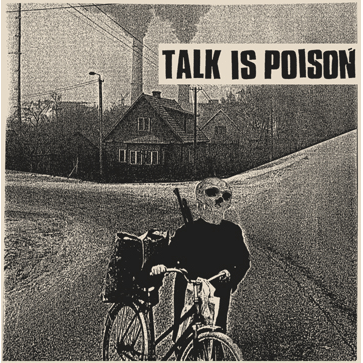
Talks is Poison - Rage to Infinity 7" (DIY)

People, pay attention! After more than 10 years, here it is: a new 7" by what is probably one of my favourite bands of all times: Talk is Poison.

To me, T.I.P. managed to create some of the best hardcore songs of the late 90ies/early 2000s. They did so by setting up camp in that space between crust and hardcore: the space carved out by bands like Crucifix, Citizens Arrest and Econochrist, and they updated the sound slightly without losing any of their punkness. Their two 7"-es and split EP with (the equally great I must say) Deathreat are absolute classics in my book. I can still listen to 'Control' or 'They Call it Law' and just want to smash everything to pieces. All three records were originaly released on Prank records, and a year or two ago they nicely re-released them as a 12" under the title: 'Condensed Humanity: The Prank EP's' 12". This should be easy to find, and even the originals shouldn't be too hard to track down.

The band has been back together for a little while now, and recently played the Chaos in Texas fest, as well as some show in the Bay Area. Included below are some recent videos of the band playing live. The first one is them playing a place called Knockout this past May and the other three are C.I.T. fest videos. I would have loved to see them live, but financially and time-wise there really wasn't any way for me to make it to Austin to see them play. Hopefully someday T.I.P. will make it over to Europe.

Now, the reformed T.I.P. brings us their first recorded output in the form of this 5 song 7" which was recorded in a single day sometime in March 2010. Fittingly, the first lines of the record are: "It still feels the same after all these years." And by listening to these songs, it does indeed feel like the band hasn't been away. A worthy addition to the T.I.P. catalogue in my opinion, and a record I for sure will be playing a whole lot the coming months.

You can order the 7" through the Bad Skulls webstore, run by the band's bassplayer Brian.

On the 'Do not resuscitate' blog I also came across a download version of it for those of you who can't control their curiosity. Needless to say: this little scene of ours exsists by the grace of people supporting their community, so support DIY bands and labels and buy a copy (!) of the record if you like what you hear.


July 25, 2010

Manipulation - S/t 7" (Fashionable Idiots records)

This 7" is one of the absolute best I've heard this year. Manipulation hails from Chicago and includes current and ex-members of bands like This is my Fist, Chronic Seizure and Civic Progress. I wouldn't have guessed from just listening to this, but apparently the band's singer is the same guy who used to sing for Pedestrians (also a great band by the way). Both vocal-wise and musically however, the stuff on this 7" is way more brutal and a lot less melodic than any of the stuff Pedestrians ever did.

The comparrison that's most acurate to describe the band's sound would be Talk is Poison. Manipulation has a similar approach to their music, in that they mix elements of a more crusty sound with straight up hardcore. The result is a sound that is punk as fuck without sounding retro (as so many bands do these days). Some of the stuff on Partners in Crime a few years back, like the No Parade 7" and Balance of Terror stuff also serve as good reference points. Considering how much I like those bands, it's no surprise I love this 7" as well.

The lyrics are bleak and have strong socio-political connotations, although in most songs, they remain somewhat vague in their exact meaning. There's definitely no sloganeering going on here, although the general sense of despair and anger certainly comes across well.

As said, this is one of my favourite 7"-es of 2010 and I can't wait to hear more from this promising band. Also check out their demo which features different versions of three of the five songs on the 7" (i.e. 'Secrets', 'End this Night' and 'Choking Man').

Glam - S/t 7" (La Vida es un Mus records) + shows in the Netherlands this week!!!

Spain has been treating us to some killer bands these past couple of years and Barcelona's Glam are no exception. Hailing from the same city as the popular and well-known Destino Final (and predecessor Invasión) there are definitely some similarities here sound-wise and fans of the aformentioned bands should definitely buy this. Hell, everyone should buy this, because it's really, really good.

Overall I would say that Glam is a little faster, the songs are shorter and their songwriting betrays more of an 80ies hardcore-influence in comparison to D.F.'s sound. Maybe it's the fact that members of the band used to play in (the also excellent) Über that shines through in the songwriting. Still, this 7" is a lot closer in sound to Invasión than it is to Über (which had more of a garagy-sound especially due to the less distorted and less heavy guitar-sound). No matter what the cause, the end result is sound that is a perfect mix of dark, D-beat-esque punk and raging straight-forward hardcore.

Having listened to it now a bunch, this is one of the best hardcore 7"-es I've come across this year. You can download the entire thing here or buy it from La Vida es un Mus records.

Most importantly: Glam are on tour at this very moment and will be playing three shows in the Netherlands in the next couple of days. They will be playing Heerlen tonight, Den Haag on Monday and the excellent SUB071 venue in Leiden on Tuesday. I'll definitely be attending the Leiden show myself, as there's no way I want to miss out on seeing these guys play live in a room that can barely hold 30 people. On top of that, Tense Reaction from Utrecht are also playing and I always love seeing them play live. Super excited about this show, and you should be too. Check out Glam's entire tour schedule on the band's myspace page.

July 18, 2010

Nerveskade - Insanity b/w Forced to Live 7" (Iron Lung records)

I don't think this Portland, OR band shares members with Lebenden Toten, but it wouldn't surprise me if they did. They definitely play a similar fuzzed-out style of punk. Or should I say: noise. Fans of bands like Atrocious Madness, Besthöven, Confuse and Kriegshog can eat their hearts out. This is completely over the top punk with an extremely distorted and screaky guitar-sound that definitely verges on totally going over into the 'noise not music'-realm. Had it not been for the driving bass, the band would probably be spinning out of control. Also, the vocal delivery is not as distorted or over the top as one might expect, which is nice.

I'm definitely no expert of the genre, but I've been enjoying this record a lot. Only drawback is that two songs on a 7" is fucking short for this kind of music. They definitely left me wanting more. Of the two tunes, the B-side is my favourite. Especialy the drums in the intro to 'Forced to Live' are powerfull as hell. No lyrics are in included in the very sparse packaging that we've come to expect from Iron Lung releases (in this case just a brown paper sleeve with the band's name stamped on it) so I can't comment on what the songs are about.

This record is released in a one-time pressing of 800 on Iron Lung records. It's the second vinyl release for Nerveskade after their excellent debut 7" on Whisper in Darkness records that is already sold out. A new Lp is scheduled to be released in a couple of months. Keep your eyes open for that one and track this 7" down in the meantime.

June 21, 2010

Masshysteri - new Lp

O.k. Just thought I'd share this with you. Got the new Masshysteri Lp in today, which I have been looking forward to for months. This song is on it. Different version though. The whole thing sounds great. Expect a review up soon.

Bloody Gears - S/t 7" (Taken by Surprise records)

Bloody Gears is a pretty new band from Boston, Massachusets. This 7" is their first vinyl release after a 5-song demo tape which was released last year. This record is released in Europe by Taken by Surprise records from Germany, and in North America throught the well-known Deranged records.

Artwork-wise I like the sparse and simple lay-out of the record. Especially the fact that from the looks of it, you can't really predict what the band will sound like. No insert, the lyrics and all the info is written on the back of the sleeve. Very sober, yet appealing.

On to the music then. My first thought after the needle hit the final was: The Estranged! And throughtout these 3 songs, the aforementioned Portland band remains an obvious reference. I would argue that Bloody Gears has a slightly less Wipers influence in their sound than The Estranged does, but the vocals of both bands definitely echo Greg Sage's. Musically, I would say this is a little more hardcore-influenced as I can definitely hear some 'Zen Arcade'-era Hüsker Dü in here as well.

Due to the Wipers/Estranged-resemblance, Bloody Gears doesn't score too many points in the originality section, however there's something about this band that (at least to me) makes them stand out from the pack. The songs are well-written. Especially the tracks 'Take a Ride' (which was re-recorded from their demo) and the opening track of the record ('End of the Line') are highly memorable. After getting this record in the mail, I tracked down their entire demo online which features some equally excellent songs. My favorites being 'Bite the Hand' and 'Pre-Occupation'.

I'm not sure what it is, but I have a feeling this 7" has the potential to slip under people's radar, only to realize in a year or two there are some really cool songs on this piece of vinyl. Do yourself a favour and don't pass this up.

June 16, 2010

Opiate for the Punk Masses

This interview with Ralf Opiate was done over the course of december 2009 through email. Ralf has been an active member of the Dutch and U.K. punk scenes for years now and runs Opiate records and distro. Over the past couple of years he has released records by Dutch and British bands such as Kriegstanz, The Last Mile, Makiladoras, Burnt Cross, Whole in the Head, Wreck of Old '98 and his own bands Orwell Nation and Staathaat. He just co-released a split 10" by Seein Red and Mihoen. He also organizes gigs in the city of Brighton where he currently resides.

O.k. Let’s start off with a short introduction; who are you and what do you do in your daily life?

My name is Ralf, 31 years old, originally born in the Netherlands now living in Brighton (UK). I have been here on and off for the past 8/9 years now. I currently work in London. With my job being so busy and commuting there pretty much every day of the week, that pretty much takes up the majority of my time. In my few spare moments I keep myself busy with organizing gigs and tours, releasing the occasional record and doing a small distro. Every so many years I also seem to find myself in a band, but I’m not doing anything serious on that front at the moment.

Can you give a short history of how you became involved in punk and how your involvement developed over the years?

I grew up in a small village in the Southeast of Holland, with hardly any shops, definitely none that sold records. So when a bunch of us started to get into louder music around '87/'88, we relied heavily on older cousins making us tapes, which we’d then copy for each other. As a result we only knew and listened to whatever they decided to share with us, which was mainly metal/hardrock, and so I was really into bands like Helloween, Guns n’ Roses, Slayer, Iron Maiden, Motorhead and especially the 1st 4 Metallica albums.

This mutual tape copying continued when we all eventually went to highschool in the “bigger town” roughly 10km away, met new people and discovered new bands as a result of it. It was still pretty much metal we listened to at the time, but slowly punk started to sneak in as well. Initially more well known bands like The Clash and Sex Pistols, but the real shift for me personally happened when I met Johan, who currently plays in Union Town and still is one of my best friends to this day. I had spotted him for a while, his Guns N’ Roses shirts and school bag with ‘Sex Pistols’ written on it, clearly singling him out as a potential alley, but once we finally got talking and hit it off, he quickly introduced me to the whole new world he was just starting to discover as well. He was able to make me tapes of the more underground punk stuff happening in the early/mid 90s, as well as 80s classics like Minor Threat, Black Flag, Negative Approach, DOA etc. Which I then of course dutifully copied again for the others.

Coinciding with all of this, a really good DIY punk thing had slowly started to develop again in the area (after an 80s heyday with Pandemonium, Disgust etc.), which Johan also definitely helped introduce me to. I believe the first DIY gig we went to together was one that Slamsquad played, a good local band who together with bands like A$O had some key players in and around them who also started organizing gigs for other groups. The annual “punk picnics” they were heavily involved in, were really important for the local scene and definitely introduced a lot of kids to a punk world outside our own local area, as well as being the perfect setting for lots of young people to get to know each other. These events were completely DIY and for a lot of us very inspiring. They definitely shaped my views of punk itself and showed me what can be done if people get together and actually do something instead of just talking and complaining.

I think that period in the early/mid 90s built the foundation for a lot of people’s eventual involvement in the punk scene. Not to mention their longevity in doing so. Many of those who were getting into it and/or were around in the area back then, later on became very active in the wider Dutch scene as well. Bands like Insult, BSE, Mary Bell, Union Town, Mallorn, Hysteria, Orwell Nation, Staathaat, Inhume, Bile, Godverdomme, Radio Bikini etc. all have/had people with their original roots in that time and place. Bearing in mind how tiny and rural that area where we grew up actually is, it still amazes me. Proportionally it probably is the part of the country that produced the highest ratio of active punks in the past 20 years...

Anyway, after a while a bunch of us started to group together more; Johan, me and 3 others. We eventually started visiting towns outside our own area for gigs as well, which coincided with us slowly getting more actively involved in punk as a whole. There was never any doubt in any of our minds that if you really wanted to experience it properly, you had to get yourself involved. Johan, always the enthusiast and inspiration, started doing a fanzine. Me and 2 other friends started doing a newsletter. It kind of snowballed from there and it just never stopped for me.

I then moved to Groningen, became friends with those who shared the same vision there (great people like Mark Shikari/Graanrepubliek Records) got involved in putting on gigs, started doing a distro, ended up in bands, etc. That’s kind of been the theme of the story wherever I have lived since, I just always try to involve myself in what is happening locally and try and figure out a way to contribute to it.

You run Opiate records; what’s the idea behind the label? What would you say is the common thread that ties all the releases together?

There’s definitely a specific common thread, but it’s not a musical one. It’s just me trying to help out friends and I only release records by people I actually know who do something that inspires me. In doing this, I am not so much interested in punk as just one specific 'sound', as one pre-agreed easily marketable set of chords if you will. I like to think of it as something that's more than just music anyway, with ideals, principles, community & politics still very much at its heart. To me that's the only way it remains relevant and to ensure it can never really be co-opted by the mainstream or by businessmen looking for a quick buck. It makes sure we retain that 'complete control' both the Big Boys and The Clash sang about I guess.

I know some people might view all this as somewhat ‘idealistic’, as if that would be a bad thing anyway. But with punk surviving as a credible underground movement for over 30 years now, I'd say there's room for this kind of idealistic optimism. That's in a time where I personally also feel some people are slightly losing sight of what's important and what makes us 'punks’. When I open a MRR these days - with all these new 'labels' just seemingly out to hype their latest pointless release with limited editions, limited pressings, special covers and whatever other mainstream record industry bullshit they can come up with to copy – it does make me wonder sometimes and does become a bit demoralizing. Personally it seems to me that if your only reason for existence as a 'label' is to sell something, however pointless, to the kids - based on style over any fucking content,
making things purposely rare instead of trying your outmost best to spread the message and making your releases available as cheap as possible to the kids (not just to the scene 'elite') – you have failed to grasp the absolute basic fundamentals. You are not helping to create a community, you are ultimately helping to destroy it, and that’s exactly the opposite of what I am interested in, and am hoping to achieve, by doing my own 'record label'.

You’re very outspoken about punk and DIY and how you view it; why is DIY so important to you? What does it mean to you?

The easy answer would be to say that I care about DIY because I care about punk. Basically I simply don’t see how the latter can exist or survive in any meaningful without the former. It is ultimately the DIY foundation, principles and ideology that gives the punk scene its strength and resilience and is what ensures it remains relevant. It is the one thing that stops it from becoming yet another product that can easily be bought, sold and controlled by, for lack of a better word, 'the system'. DIY is what makes punk inspiring. It’s anarchism in action. It empowers young and old kids alike, giving them complete control to fight back in whatever way suits their own personality, circumstances and opinions best. It is a fucking radical idea if you think about it: don’t wait around, don’t swallow the shit others feed you. Get up and do it yourself, your voice, your opinions. It plants the seeds of true resistance in every new generation of punks. And it is the one and only reason why punk still fucking matters.

Do you then (and if yes, how?) still view punk as a valid means of resistance?

Definitely! I don’t see why it wouldn’t be. What’s actually changed? It has lost nothing of its the power to educate, because we own our own means of communication. Nothing of its power to organize because we are its organisation. People who try and portray the political side of punk as something of yesteryear either have not been paying attention or have their own personal agenda in doing so. Punk is by definition political and has been at least since the late 70s. It, and everything that is connected with it or grew out of it, has always been at the forefront of resistance against the capitalist system. Our means of organisation are extremely political and have proven time and time again to hold a huge potential for 'resistance'. Not only that, we share between us a long detailed history of 'radical' ideas that are kept alive through lyrics, zines, benefits, bands and the worldwide DIY ‘network of friends’. They inspire each new generation coming into our community, showing them alternatives they would otherwise never have been exposed to. Punk opened up a whole new world for me. It changed my life and the way I look at things, and you’d be hard pressed to find many punks who do not have a similar experience. Yeah, that all sounds idealistic and it’s not something you hear people say as much anymore nowadays, but it doesn’t make it any less true. It’s something I think we should remind ourselves of more often. It probably wouldn’t hurt to sometimes make some more effort to keep that side alive. To reach out more actively to the new generations coming in and to share ideas and politics we by now might take for granted ourselves, but which won’t be to them yet.

With all the focus on records and new releases (and since I know you love records yourself as well) doesn’t punk run the risk of becoming a hobbyist clique of late 20/mid 30-ish recordcollectors?

I don’t think punk will ever ‘become’ something. It is ultimately defined by our actions and combined efforts. Remember those stickers that said: 'punk can’t be destroyed, because it never existed'? I never really understood what it meant then, but it has started to make real sense as I’ve gotten older and been involved longer. It comes back to what we talked about before; because punk is organized along DIY foundations, no one is going to dictate to us what this is about nor going to be able to kill if off. It is what we want it to be and we can shape it however we see fit.

Now having said that, I do know where you’re coming from of course. There are elements sneaking in I’d like to see us counter more vocally, but it’s probably also not something that should be overestimated. When you talk to the people who really keep the scene alive, not just the people who post more actively on internet forums, you realize a lot of them still work from a different template and are involved for reasons that go much deeper than just getting certain records. Most really aren’t that interested, or even aware, of all the supposed 'must have! limited to 50 copies' releases that say little and contribute even less.

Now I love records and I definitely buy a lot, but it doesn’t stop me or similar people around me from continuing to contribute to the scene as a whole. I love punk. I don’t want to be on the sidelines. I want to be involved and I want to see everything, hear everything. I get excited. I love every element of it. I don’t care about getting the original first pressing or coloured vinyl, and think all this limited bullshit is corrosive, but not enough to really affect the basic foundation. As long as there are people who are angry, there will be people who find a place in punk and will continue to make sure it never ends up becoming the above nightmare scenario.

What’s the biggest difference between Amsterdam and Brighton? Why move back to Brighton?

I initially moved to Brighton to be with my girlfriend. She didn’t have a passport at the time due to her being a refugee and with the European immigration laws being what they are, this was the only place where we could be together. When she finally got her passport and moved back to Bosnia for a while to be with family, I thought I’d give Amsterdam a try. I loved it and we planned to live there together for a bit, but ended up moving back to the UK when she got offered a job at an anti-hunting charity in London.

I love Brighton though, so it wasn’t much of a sacrifice to move back. It’s a beautiful place and a great easygoing seaside town. Like Amsterdam, it is very different from the rest of the country it’s in and in a real 'bubble of it’s own'. Brighton, like Amsterdam, is basically the kind of place people who can’t or don’t want to live in the rest of the country move to. It’s the gay capital of the UK. You can get vegan/veggie food in pretty much every pub/restaurant/shop here and we probably have the same concentration of organic, health food, hippy etc. shops cities like San Francisco (a town, despite the difference in size, Brighton is actually often compared to) have. It just really suits me here. I left the area where my parents live because even though there are some really good people there, I wanted to live in places where people had more political and social ideas comparable to my own and where things were generally just a lot more open-minded. Both Brighton and Amsterdam tick that box. Life is just too short to live life in a boring soul-destroying places as far as I am concerned.

I think one main difference for me between the two cities – besides the wider cultural and political differences between the two countries itself – is that the squat culture and all that is connected to it (which is so present in Amsterdam and underpins the Dutch punk scene as a whole) is a lot less part of it over here. Or when it is, is so in a very different way.

When I lived in Amsterdam I was involved in the OCCII – an autonomous space, run by great people with a healthy non-bullshit political attitude – which is the place I organized all the gigs I did. In Brighton I try and do them in our two local autonomous places - the Cowley Club or the Westhill Community Centre for bigger shows – as well when these are available, but ultimately you do end up having to use pubs sometimes, which is perfectly fine and just the way it is, but it does create a totally different atmosphere and scene.

What’s the scene in Brighton like? What cool projects, bands, initiatives, zines, etc. should we be on the look-out for?

All in all Brighton is a very social and outgoing place and that’s reflected in the scene; punk, noise and all things related, with pretty regular socializing outside of gigs. It’s a pretty transient town, which means things go through motions, although there’s a strong core of mostly older folks who are firmly rooted here and consistently support whatever is going on. It has been pretty active band-wise for a few years, but we might be starting to hit somewhat of a slow patch. Then again people are always working on new projects, so who knows. Hopefully the new schoolyear (we have 2 universities here) will see the arrival of some fresh faces eager to get involved as well.

A few bands have disbanded over the past few years, including more known names like Burning Times, End The Agony and Fall Of Efrafa (who played their last gig at the Westhill here last night – with people from all over the world travelling down to see them one more time). Some of the still active ones include Constant State of Terror (metallic crust punk w/ ex-MTA & Substandard folks), Burnt Cross (really great anarcho punk) and Flatpig (long running old-timers). Jovian is a seriously amazing new band with End The Agony people, while Sceptres (angular punk like X) and Serf Combat (melodic punk) have locals in their ranks as well. The noise scene is also very healthy, with lots of good people doing stuff I might not always understand, but which is always DIY, creative, inspiring and ultimately punk as fuck.

Zine wise there’s some real quality – and zine culture as a whole is incidentally much more part of punk here than it is in Holland – with Remains Of A Caveman, Zonked, Morgenmuffel and The New Wave Of Cut N’ Paste being the cream of the crop and well worth searching out.

Other than that we have a little punk shop (Punkerbunker) and the previously mentioned Cowley Club that besides gigs also does a weekly vegan evening meal and sells a good selection of political books/zines among many other things. Finally there’s a bunch of people who do labels, with Tadpole Records run by Darren being the best and most active.

I know you work in an non-profit organization in London; what kind of work do you do exactly; how does the work you do relate to how you view punk? Do you ever feel a conflict between working within the system and maybe more radical ideas that you have about what society should look like?

I work as the ‘Information Coordinator’ for a small pan-London wide homelessness charity. I am responsible for the information team. We manage our client’s data (which includes things like their individual support needs and work that’s being done by frontline staff to address them) and make sure support workers have the ability to record the information they need to. We monitor and analyse the information to ensure that often vulnerable & chaotic people get the care they require and should be entitled to, and as an organisation we’re able to prove this to current, and potential future, funders. In this capacity I also do a lot of work with our fundraising team on bids for new projects, and provide data & reports to a variety of other interested parties. Basically it means making visible and tangible the work we do as an organisation with our clients.

I am lucky enough to work in a place and with people who hold values that are in line with mine. It’s a pretty non-hierarchical organisation where the motive is most definitely not ‘profit’ or ‘growth’ but instead focussed clearly on helping to turn people’s lives around, all the while treating them with dignity and respect – which sadly enough isn’t always the way at some of the bigger organisations in the sector. Our recruitment policy for staff is pretty gruelling and long, you really need to want to work here basically, but as a result the people I work with are pretty much all excellent at their job and have a real 'above and beyond' attitude and enthusiasm to helping our clients. It is inspiring how far some clients can come with the right support and I am very happy to be able to contribute to something like that on a daily basis. To me the issues our clients are faced with are at the core of what’s wrong with the capitalist political system, and fighting back through our work fits in well with how I view punk as well.

I don’t feel any conflicts about this set up. Sometimes you might like things to be different, but this is the real world and I very much believe in being part of that. We have to deal with the society we have right now first, before we can even hope to get to something that’s better. For your politics to matter, I don’t think completely isolating yourself from the system is the best way forward. I know there’s a strand in punk and supposed (!) radical circles that disagrees with this and even likes to dismiss anyone outright who either has a job or at least doesn’t work in one of the ‘approved’ ones/sectors, but I never had much time for that. I definitely have certain ‘radical’ ideas, but also care about them seriously enough not to go down that isolationist path that’s ultimately doomed for failure. Whether you work in the charity sector or somewhere else, I think Zounds hit the nail on the head when they said : “if you got a job/you can be an agent/you can work for revolution/in your place of employment.“

Why did Staathaat break up? I’ve heard rumours of Staathaat getting back together. Is that true? If not, are you thinking about starting any other bands?

Against all the odds we kept it going for another year or so after I moved back to the UK, even cramming in gigs/tours around Spain, France, Belgium and Holland, but all things come to an end at some point and in the case of Staathaat it was when Thale, who played guitar, wanted to focus on other things musically. I have not heard anything about us playing again, but I do know the 3 of them have recently started jamming with a new band. That’s probably where your wires got crossed? Myself, I am always thinking about starting new bands, but I am also a bit picky when it comes to the people I’d like to do that with. I’ve been a bit spoilt in the past where I always managed to do something with punks with similar ideas and beliefs, and though that’s not always easy to find, it matters more to me than people’s musical ability. One day I am sure I’ll do something else, but in the mean time I’ve got enough on already to keep me way too busy…proven by the fact it took me a good few months to even complete the questions above!

June 14, 2010

Daylight Robbery - Through the Confusion Lp (Residue records)

Daylight Robbery are one of the cool bands currently coming out of Chicago and, at least to me, one of the most interesting bands coming from the U.S. these days. With Through the Confusion the band delivers its first full length record and third release in total. As their two previous efforts, 2008's Washtenaw 7" and last year's Red Tape 7", the new Lp is released through Residue records which in the past two years also released records by such great bands as No Slogan, Sacred Shock, Canadian Rifle and Defect Defect.

The music is melodic punk with dual male and female vocals that bring to mind X (as an obvious reference) and more recent bands like Gorilla Angreb and Masshysteri. Overall DR's music is a little more angular then the above mentioned bands, which hints at a healthy dose of British post-punk influences.

This band's main asset is definitely their ability to write extremely catchy melodies and to package them in seemingly simple, yet haunting songs. They already proved this with their excellent song (and personal favorite of mine) 'Circles' on last year's Red Tape 7". This new record again displays the band's skills in songwriting, and tracks like 'Victim of the Late World' or the opening track of the album 'Mystery' will be stuck in your head in no-time and are also two of my favorite songs on the album.

In all fairness, I must mention that there's nothing too groundbreaking going on on this record. But with songs this good: who gives a shit. By going back to a classic punk sound, making it their own and writing some simple yet great tunes, Daylight Robbery are, in my humble opinion, one of the most interesting bands around these days and this record is everything I had hoped for. Definitely a record that will end up in my top 10 of favorite records of 2010.

You can listen to the record and decide for yourself on their site. Also, check out the video below of them playing the song Mystery live.

August 17, 2009

Fight War, Not Wars! British Peace-punk in retrospect: a review

Again, a piece I wrote for RE/fuse issue #6. This time a lengthy review of some of the records and books that have come out over the past couple of years documenting the rise of U.K. peace-punk in the late seventies and early eighties. This review is already somewhat older, but I'm currently in the middle of generating some brand new content for this blog, so keep your eyes open for future installments. Untill then: enjoy!


George Berger – The Story of Crass (Omnibus Press, 2006)

Ian Glasper – The Day the Country Died: A History of Anarcho Punk 1980-1984 (Cherry Red Books, 2006)

V/A - Anti-War: Anarcho-Punk Compilation Vol. 1 CD (Overground Records, 2005)
V/A - Anti-State: Anarcho-Punk Compilation Vol. 2 CD (Overground Records, 2005)
V/A - Anti-Society: Anarcho-Punk Compilation Vol. 3 CD (Overground Records, 2006)
V/A - Anti-Capitalism: Anarcho-Punk Compilation Vol. 4 CD (Overground Records, 2006)


When I first discovered Crass, I must say that right from the start they confused me more than they actually spoke to me. Their version of punk was unlike anything I had heard or was listening to at the time, and their lyrics, though obviously political, seemed weird and did not match any politics I had come across up until then. As a whole, the band and the music seemed rather uninviting and incomprehensible, yet somehow I stuck with it and over time grew to love them.

Maybe the fact that I didn’t ‘get them’ at first, was because I was listening to them in 1999, not in 1977. When Crass originated I wasn’t even born, and while the Cold War was shaping the world in the 1980s, I was at home playing with my Lego’s. By 1999, when I got my hands on my first Crass CD, Best before…1984 the world was arguably equally bleak as it had been in 1977 (or 1984 for that matter), but the deplorable state of the world was only just starting to seep through to me. The validity of the themes that Crass were addressing in their songs had not yet reached my high-school punk mind. Despite the encircled ‘A’-s I drew on my backpack, I only had a vague clue about what anarchism was, and that clue mostly came from my Propagandhi records. I could relate somewhat to the band’s anti-Americanism (as expressed in 1984’s Smash the Mac) or their anti-organized religion sentiments (Reality Asylum) but the underlying feminist critique was largely lost on me, nor did I really understand what the hell all their talk about the Falklands was all about or what they meant by their constant reference of Nagaski (hey, wasn’t bombing the Japanese the reason ‘we’ won WWII?).

On top of all this some of their songs were rather horrible. Though at this point I can see the artistic value of a song like Nagaski Nightmare, it is still hard for me to listen the whole tune from start to finish without skipping it and moving on to the next one. But no matter how ‘unlistenable’ some of their songs were, and might still be, what they did do was intrigue me. I instantly felt that whatever it was that Crass were about, at least it was something genuine and dangerous, thereby urging me to delve deeper into their music, their words and their beliefs. The fact that I knew almost nothing about the band, except for the short outline of the band’s history as included in the booklet accompanying their aforementioned Best before… CD only added to the enigma as did the fact that I had a hard time believing all the stuff in there was actually true. Especially the pranks the band pulled on Teen-magazine Loving by convincing them to include a single by Creative Recording And Sound Services (C.R.A.S.S.) with their magazine in 1980 and the fabricated tape of a fake conversation between Tatcher and Reagan the band send to the press in 1982 seemed surreal and made me question whether the band wasn’t grossly overstating their own importance.

Luckily for me, there is now George Berger’s The Story of Crass to shed some light on that enigmatic band. The book covers the history of Crass as experienced by some of the principal players involved, both in and outside of the band. Despite the fact that the voices of drummer Penny Rimbaud and vocalist Steve Ignorant are the dominant ones in the book, almost all former Crass members have been interviewed for this publication. Although my major critique of the book would be that the editors did a lousy job, leaving in way too many spelling errors and other little mistakes, I do think the book does a good job in describing the history of the band and putting the band’s development into context.

Crass was started in 1977 by thirty-something Dial House (the communal house were the band members ended up living) founder, former art-teacher and drummer Penny Rimbaud and a young punk by the name of Steve Ignorant, who came into contact with the house because his brother used to jam with Rimbaud in a band in the mid-seventies. The band soon expanded into a collective consisting of guitarplayers Andy Palmer and Phil Free, bassplayer Pete Wright, additional singers Eve Libertine and Joy de Vivre, filmmaker Mick Duffield and artist Gee Vaucher. If the book shows one thing, than it is that, even though the band remains relevant today, Crass needs to be understood in its time, through the history of its members and its development as a band. Crass in more ways than one, was a residue of the 1960s. Several of the band’s members had gone to art school during that decade and were influenced by pop-art and performance art, which would later shape the development of the band into incorporating movies into its shows. There was also a strong hippy-element present in the band which led to their political awareness and, for example, their connection to some of the early free festivals in Britain.

But besides being influenced by the sixties, the band was also a product of the seventies and the economic and political climate of those days. Their angst ridden music and lyrics denounced capitalism, war and oppression. In disagreement with both sides in the Cold War, Crass chose another road, that of anarchism, thereby denouncing both the capitalist power structures as their supposed adversaries, the established socialist and communist parties. While Johnny Rotten had proclaimed to be ‘an anarchi-e-st’ (and that he ‘really meant it, maaaaaaaaaan’), Crass actually seemed serious about their non-partisan politics, thereby appealing to hundreds, if not thousands, of young people growing up with the threat of nuclear war hanging over their heads.

As with any good example, other bands taking Crass’s cue were soon to follow. Fed up and disillusioned with the stars of the first wave of punk bands, or a few years to young or living too far from a city to have been there at the start of the punk scene, youth all over England had nevertheless been inspired by punk’s energy and were looking for ways to transform that energy into something of their own. As Sean McGhee, ex-Psycho Faction vocalist and compiler of a 4-CD retrospective on Overground Records of the Anarcho-Punk (or Peace-punk) scene that Crass helped spark in the UK in the early 80ies writes: “Let’s face it, by 1979 Punk was dead on its feet, the inspiration, excitement and passion absorbed by both the music business and an increasingly insipid New Wave. Out in the suburbs and those rural placed that no-one ever visits, there was a whole generation of kids too young to be part of the ‘art school’ elite of those early punk days, but certainly old enough to have felt the initial gut reaction and life-changing ability of the punk beast.”

Crass were the catalyst that changed punk for McGhee and for many other young people in the U.K. and again infused it with relevance and excitement. The band traveled all over the U.K. to play gigs and wherever they went, new bands would spring up in their wake. As said, the scene the band helped jump-start would be referred to as the anarcho- or peace-punk scene. The history of this part of the Britisch punk scene has been documented by punk-historian Ian Glasper in his recently published second book on British punk, The Day the Country Died: A History of Anarcho Punk 1980-1984 . The book is an overview of the peace-punk scene of the early eighties and covers about 90 (!) bands from the era. The bands are categorized by region (London, Wales, Scotland, etc.), following the model that Glasper used in his previous book on punk in England Burning Britain: The History of UK Punk 1980-1984, in which he described the second wave of British punk by focusing on the likes of Abrasive Wheels, Varukers, Discharge, the Exploited and GBH, to name a few. Numerous people interviewed by Glasper in The Day the Country Died cite seeing Crass play live as an eye-opener and an incentive to form new bands or to revive and drastically change their old ones.

A portion of the bands that came into being during the era were outright Crass-copycats. While listening to the four-CD retrospective of the early 80ies anarcho-punk scene on Overground records, you’ll notice how some bands in the scene followed Crass’s musical blueprint of Rimbaud’s almost militaristic drums-style, the band’s staccato guitars and its political lyrics, belched out with venom and spite by singers Steve Ignorant, Eve Libertine, Joy de Vivre and, occasionally bass-player Pete Wright.

Something else that was adopted from Crass by a large part of the scene, and which shaped the look and image of punk for the decades to come, was the band’s decision to solely wear black on stage, giving them a dark image that flirted with fascism, even though that wasn’t the band’s intention per se. According to Steve Ignorant in George Berger’s book The Story of Crass, wearing black clothes was simply a result of the entire band living together in a house and sharing a washingmachine. “The true story is that we used to have this really old washing machine. Someone fucked up the washing so that all the clothes – including my white socks – came out this grey mushy colour. It was a pain – doing eight people’s washing – so we just thought let’s dye it all black – it’ll look smart and won’t be such a hassle on wash day.” Though maybe come up with as a practical solution for wash day, the image of the Crass-members all dressed in black, with black amps and instruments, added to the mystique around the band and intrigued many fans of the band to adopt a similar style, doing away with the more colorfoul punk-fashion of bands like the Pistols.

The critique of an entire scene of Crass-copyists is far from valid however. The sounds on the four CD’s are extremely diverse. Even though all the bands on the ‘Anti-…’ CD’s share a certain connection to the only-vaguely defined ‘anarcho-punk’ or ‘peace-punk’ scene, that was hugely influenced by Crass. And many were (stylistically and musically) influenced and inspired by Crass or somehow connected to them and their labels Crass records and Corpus Christi in one way or another (for example through the famous Bullshit Detector compilation Lp’s). As said, there are those bands that diligently followed Crass’s cue, yet there were also many bands that incorporate other influences into their music. For example, there’s the folk-influenced music of bands like Astronauts, Blyth Power and Danbert Nobacon (a one-man acoustic project band of a member of Chumbawamba who themselves also incorporated a significant folk-influence in their music), the political Oi-anthems of Scotland’s Oi Polloi and the female-fronted, almost poppy punk of Icon A.D. From the dark, heavy onslaught of bands such as Amebix or Antisect, to the stripped-down two man band D&V spitting out lyrics over nothing but drums (in a time before two-man bands were the hip thing). From the melodic and soulful, yet angst-ridden, songs of the Mob and Zounds, to the overtly political fast-driven compositions about Animal Rights and other issues of Conflict. From the Subhumans to Flux of Pink Indians, from New Wave-like melodies, to dark, angry hardcore-punk, the Anarcho-Punk scene encompassed it all and the amount of diversity on these four CD’s is one of their prime assets and I can recommend all the CD’s to anyone interested in this era of punk. They certainly inspired me to start digging deeper into the history of this part of the punk scene and to rediscover some old bands that I hadn’t listened to in a while.

The CD’s and the songs on them, as well as both the books, in words and pictures, echo well the bleakness of what the early eighties must have been like. The Cold War was still in full-swing, with the arm’s race being given a new boost by a certain mr. Reagan residing in the White House and a certain mrs. Thatcher at Downingstreet 10. Unemployment was rampant, creating a lot of dissatisfaction among youngsters, while also giving them enough time to transform that discomfort into music, zines and political action. The stories told in words, songs and pictures show a generation of kids growing up in a world that warranted little hope for the future, yet instead of accepting it, these kids, even through limited actions and with limited means, decided to fight back. By writing songs, venting their frustrations at callously wasted lives of people and animals all over this planet and the destruction of the earth around them, they transformed music into something more. Hopefully these publications will spark a renewed interest in these bands and their ideas.

Undoubtedly the anarcho-punk scene also had its flaws. Stories of holier-than-thou attitudes in the scene (more vegan than you, more anarchist than you, etc.), drug use and other problems regularly come up in the interviews Glasper conducted for his The Day the Country Died and even Steve Ignorant in Berger’s book talks about how he was getting fed up with having to discuss anarchism with the fans of the band after every gig. However, the scene inspired many who would often go on to channel their energy into worthwhile projects and causes. Some of the punkclubs that still exist in the U.K. until this day are residues of the energy that these punks invested into their scene.

What I would have like to have seen however, in both Berger’s as well as Glasper’s books, is a more thorough analysis of the politics of the Anarcho-punk scene and what the contribution of those ideas and politics in the larger scheme of things was. The primary focus is on the bands, which is understandable in many ways, but one of the things that makes the Anarcho-punk scene of the early eighties so inspirational, is that these were bands often had very radical points of view. It would have been interesting in my opinion, if more time had been spent on analyzing those ideals and what became of them in the long-run, in a context beyond just the punk scene, but of British society as a whole. It would have been interesting for example to discus the connections between the anarcho-punk scene of the late 1970s and early 1980s and the autonomous movement that was emerging in Europe at the same time. Glasper for example uses pictures of the Stop the City demonstration in 1983 on the cover of his book, but never really goes into the effects of those demonstrations on the larger scheme of things or into the Anarcho-punk scene as a movement for change. He doesn’t really cover or analyze CND (Campaign for Nuclear Disarmament) or Stop the City as separate entities, but only discusses them in relation to some of the bands and band-members who were active in such initiatives. This also happens with Glasper’s coverage of the rise of the ideas of vegetarianism and animal liberation (like the ALF) within the anarcho scene, which he discusses in his paragraph on Conflict, but which he does not really analyze beyond that. This is a minor point of criticism though, as I understand why Glasper has chosen to focus primarily on the bands and to provide an overview of the scene. In this he succeeds, and his book is a must-read for anyone interested in British punk, anarcho-punk or any of the bands from that era.

In closing, Berger’s The Story of Crass, Glaspers’ The Day the Country Died and the four CD’s on Overground Records were longtime overdue. With all the attention given to American hardcore and first wave British bands like The Sex Pistols and The Clash over the past few years, Crass (though arguably one of the most important punk bands of all time) and the scene they helped spawn have been grossly overlooked. I urge everyone to check out these books and records and the bands they focus on. Highly recommended.